Workplace wellbeing is neither a veneer of cheerfulness nor a handful of productivity hacks.
It touches very concrete dimensions: energy, sleep, mental load, quality of relationships, clarity of priorities, sense of safety, and your ability to recover and sustain effort over time.
When that balance slips, “getting more organised” is not always enough. You also need to understand what is really going on, what can be worked on in coaching, and what belongs with a doctor, psychologist, HR, or the organisation itself.
That is where many people get lost. They sense something is wrong but cannot always name it or know whom to approach. Is it just a busy spell? Chronic overload? Poor recovery habits? Mishandled conflict? Deeper exhaustion? A work-design issue? Or already a health matter beyond coaching?
This guide helps you sort that out with more clarity.
What do we mean by workplace wellbeing?
It describes how someone experiences their job over time.
It does not depend only on motivation or individual toughness. Several factors shape it:
- workload and pace;
- clarity of role and priorities;
- quality of relationships with manager, team, or clients;
- ability to focus and recover;
- sense of usefulness, recognition, and coherence;
- physical and mental state while working.
In other words, wellbeing at work is not only a feeling. It is also about structure, how you function, boundaries, environment, human dynamics, and sometimes health.
The goal is not a perfect, friction-free state. Work inevitably involves tension, demands, surprises, and hard periods. The real question is whether you still have enough bearings, resources, and recovery margin to go through those strains without lasting harm.
When the answer is no, the topic deserves to be taken seriously.
Why workplace wellbeing is often framed poorly
It is often discussed in vague terms.
Sometimes it shrinks to lifestyle tips: sleep more, move, breathe, take breaks. Those levers help, but they fall short when the issue is impossible load, fuzzy roles, ongoing conflict, or a way of operating that has become too costly.
Conversely, some people psychologise too fast. If they suffer, they assume they must be bad at emotions, organisation, or boundaries. That is not always true. Some difficulties start with how work is organised, how people are managed, contradictory priorities, or an objectively harsh environment.
So avoid two mistakes:
- believing habits alone fix everything;
- believing everything is always “your fault.”
Wellbeing at work usually sits at the intersection of personal, relational, organisational, and sometimes medical factors.
When can support help?
Support can help when you feel imbalance setting in without it necessarily being a clinical emergency.
Common situations:
You feel constantly on edge
You struggle to switch off, think about work all the time, feel irritable, tense, or almost always vigilant. Even when the day stops, your nervous system seems still “on.”
Your mental load becomes overwhelming
Too many topics at once, constant interruptions, shifting priorities, difficulty delegating or finishing what truly matters. You react more than you choose.
For related reads, see the stress, burnout, and mental load cluster.
You sleep or recover poorly
Sleep is disrupted, fatigue lingers, you feel on reserve. Even after a calmer weekend you do not feel restored.
Work relationships weigh heavily
Tension with a manager, difficulty setting boundaries, low-grade conflict, feeling disrespected, fear of displeasing others, or needing to take your place without burning out.
Your way of functioning feels unsustainable
Over-adaptation, perfectionism, difficulty saying no, absorbing everything, guilt when resting, inability to slow down, need to control everything: it may not be “who you are,” but it can be how you have learned to cope—and sometimes that coping becomes the problem.
You are coming back from a hard period
After leave, exhaustion, sharp conflict, a role change, or prolonged overload, rebuilding a more sustainable rhythm may matter more than picking up exactly as before.
In these situations, support can restore clarity, rebuild reference points, and work on concrete adjustments.
Early signals and red flags
Not every discomfort is burnout. Yet some signals deserve attention.
Early signals
They are often dismissed because they creep in gradually—yet acting then is especially useful.
Common examples:
- recurrent fatigue;
- unusual irritability;
- trouble concentrating;
- feeling saturated;
- loss of perspective;
- more fragile sleep;
- lasting drop in motivation;
- harder recovery;
- feeling “always slightly behind”;
- never mentally “finishing” the day;
- withdrawal or loss of drive.
They do not always mean medical care, but they signal that readjustment is needed.
Red flags
These call for more caution—they may go beyond ordinary work discomfort.
- marked exhaustion that will not lift;
- collapse of energy;
- persistent physical symptoms;
- strong anxiety;
- significant weight loss;
- palpitations;
- frequent crying spells;
- inability to manage ordinary tasks;
- feeling on the edge of breaking;
- dark thoughts.
Do not minimise this. See a health professional.
What a coach can actually work on
A coach does not diagnose or treat. Yet they can help concretely on several wellbeing-related dimensions.
Clarifying the situation
Name what truly drains you: overload, ambiguity, hyper-solicitation, conflict, missing boundaries, isolation, costly coping patterns, difficulty arbitrating or letting go.
Many people arrive saying only “I feel bad” or “I am saturated.” Useful support moves from diffuse unease to a clearer picture.
Reprioritising and restructuring
Map tasks, separate urgent from important, protect focus time, spot what can be delegated, postponed, or renegotiated, and step out of purely reactive mode.
It is not only “being more organised.” It is regaining discernment in how you spend energy.
Healthier boundaries
Saying no, asking for trade-offs, refusing extra asks, making overload visible, framing availability, limiting digital intrusion—these are simple in theory but hard in practice. Coaching explores what blocks them and how to phrase them more steadily.
Sustainable habits
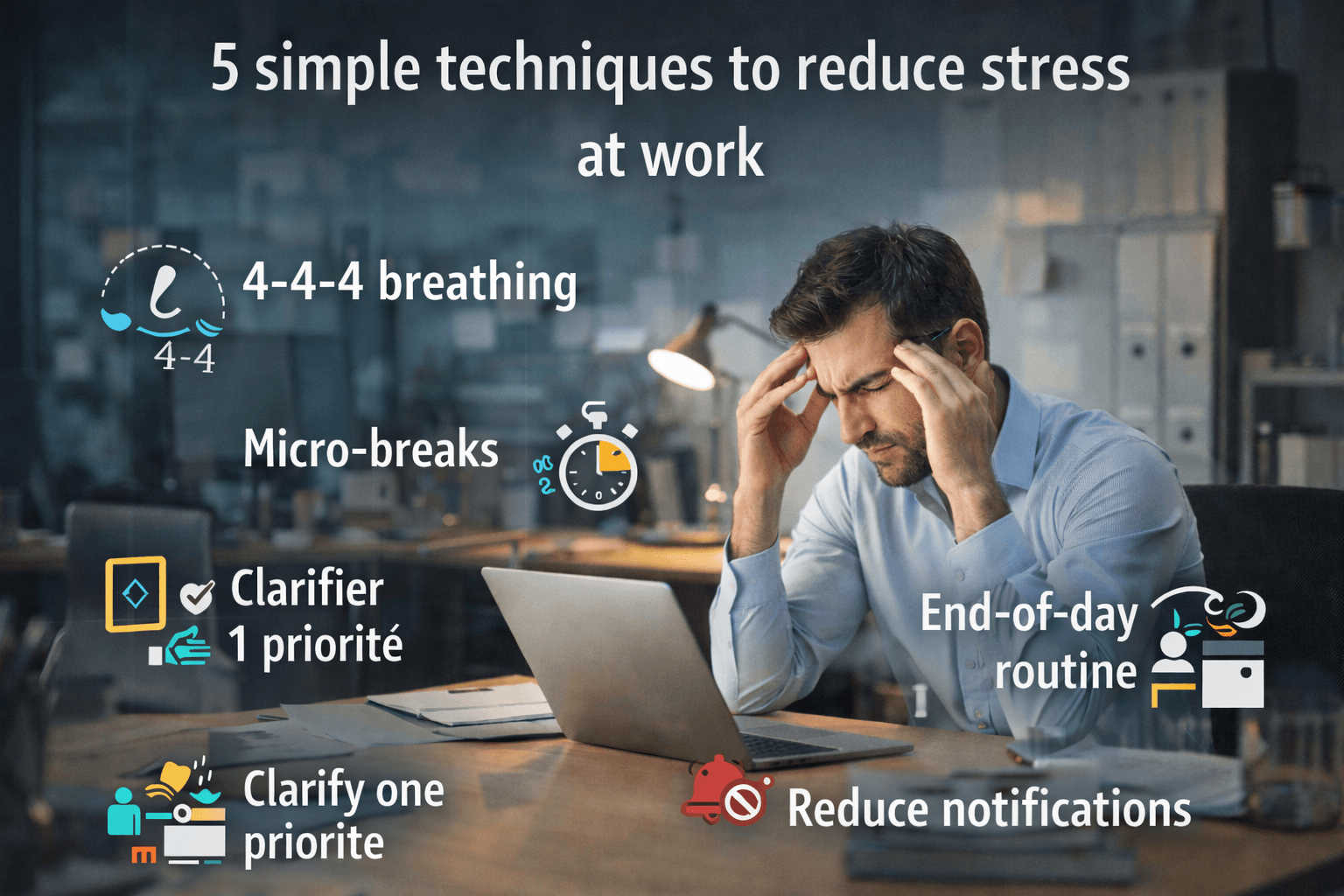
Wellbeing also rests on micro-adjustments: transitions between work and life, real breaks, recovery, notifications, sleep protection, movement, breathing, cutting needless friction—without idealistic routines you cannot keep.
Relationships
Prepare hard conversations, express needs, ask for clearer framing, move out of over-adaptation, take space without aggression or erasure.
Return or reorganisation phases
After difficulty, coaching can help rebuild a tenable rhythm when medical follow-up is in place if needed.
What coaching does not replace
This is central.
Coaching does not replace:
A doctor
Clinical symptoms, deep exhaustion, major sleep disruption, strong anxiety, or unusual physical signs mean coaching alone is not enough.
Therapy
If psychological pain, trauma, depression, or deeper disorders dominate, you need a mental health professional.
HR or employment law
Coaching can help you prepare a conversation or clarify your stance. It does not replace HR processes, internal mediation, or legal advice.
Organisational change by itself
A coach can help you act inside an imperfect system. They cannot alone compensate for chaotic organisation, toxic management, or objectively unmanageable load.
Coaching must not become a polite way to ask someone to endure the unbearable.
Coaching, care, HR, management: who does what?
Confusion often starts here. Separating roles changes everything.
The coach
Works on behaviours, reference points, habits, choices, boundaries, coping patterns, and how you act in a given situation.
The doctor or health professional
Assesses health, spots symptoms, diagnoses when needed, and delivers care.
The psychologist or therapist
Addresses psychological pain, wounds, deep patterns, or disorders beyond work alone.
HR or the manager
Act on workload, priorities, internal schemes, team conflict, or organisational decisions.
One issue may need several layers. Do not expect a single intervention to cover everything.
How to know whom to turn to
Simple markers:
Coaching may fit if you want to:
- regain clarity;
- handle mental load better;
- set boundaries;
- reorganise how you work;
- prepare a delicate exchange;
- build a frame for concrete adjustments.
Coaching can help—but not alone—if:
- you return from major exhaustion;
- you already have medical or therapeutic follow-up;
- the issue spans functioning, health, and the work environment;
- you need both practical adjustment space and clinical care.
See a health professional first if:
- you are severely depleted;
- physical or psychological symptoms are marked;
- sleep is badly disrupted over time;
- you feel clearly overwhelmed;
- you have dark thoughts or a global collapse.
Also look at the work system if:
- load is objectively excessive;
- roles are fuzzy;
- management fails;
- availability boundaries are ignored;
- the issue is structural more than individual.
Concrete scenarios
Case 1: overload without clinical collapse
You still function but end days drained, sleep worse, feel irritable, and cannot prioritise. Coaching fits well to clarify what overloads you, rebalance trade-offs, set boundaries, and regain sustainability.
Case 2: return after exhaustion-related leave
You fear repeating the same patterns. You need to rebuild bearings and protect energy—not resume identically. Coaching can help alongside continued health follow-up when needed.
Case 3: recurring conflict with a manager
The core issue is relational and organisational. Coaching can prepare conversations and restore agency, but persistent dysfunction also raises HR or management questions.
Case 4: strong physical symptoms and global breakdown
Poor sleep, palpitations, frequent crying, inability to do normal tasks: coaching is not the first step—prioritise health care.
Choosing support on Miraye
The goal is not only a visible professional but a readable one.
Look especially at:
- topics they explicitly support;
- how they discuss stress, mental load, sleep, balance, work relationships;
- their working frame;
- clarity about limits;
- formats offered;
- approach—highly structuring, exploratory, or mixed.
A strong profile should show quickly whether they may fit—without vague promises.
Questions to ask yourself before starting
- Is my issue mainly organisation, health, relationships, or personal functioning?
- Do I seek distance, concrete change, or emotional support?
- Is my current state compatible with coaching, or do I need medical or psychological input first?
- What kind of frame do I need to move forward?
- Does the professional clearly state what they do and do not do?
- Do I expect solutions, clarification, or long-term behaviour change?
- Is my problem compatible with coaching or does it need another form of help first?
Useful questions to ask a coach before committing
- Which workplace wellbeing topics do you support most often?
- When is coaching not appropriate?
- How do you set the working frame?
- How do you spot when something belongs with clinical or other professionals?
- How do we know the work is on track?
- How do you work on mental load, boundaries, or work relationships?
- How do you avoid loading the individual alone with a problem that also belongs to the work system?
These are not traps—they check whether the approach is clear and serious.
Common mistakes to avoid
Trying to fix everything alone for too long
Many wait until breaking point. That is rarely the best strategy.
Confusing performance with sustainability
Still functioning does not mean you are well. You can perform while wearing down.
Chasing only tips
Routines help but do not replace real clarification when the issue runs deeper.
Blaming only yourself
Sometimes habits matter; sometimes the frame matters. Avoid total individualisation.
Blaming only the context
The reverse exists: some patterns deserve honest personal attention.
FAQ
Does wellbeing coaching replace medical care?
No. It can support behavioural and organisational adjustments, not diagnosis or medical treatment.
Can therapy and coaching combine?
Often yes, if roles stay clear and each stays in scope.
Can coaching help after burnout?
It can support return, reorganisation, or healthier habits, but not replace care when exhaustion is severe.
Is it always the person’s fault?
No. Some issues clearly sit with organisation, management, team culture, or imposed load. Do not over-psychologise or over-individualise.
Can I see a coach before I am “at the end”?
Yes—often that is better. Coaching can be especially useful when early signals appear.
How do I know support really helps?
Useful support is not only feeling heard. Over time you understand better, choose more clearly, set more realistic boundaries, and regain a more sustainable rhythm.
Conclusion
Workplace wellbeing is not reducible to motivation, discipline, or a few lifestyle tips.
It is a broader balance of energy, work design, relationships, habits, boundaries, and sometimes health.
Coaching can work on part of that balance—clarify, adjust, set boundaries, reorganise, rebuild sustainable bearings.
It must not be sold as universal. When issues turn clinical, medical, therapeutic, legal, or structural, seek the right level of response.
On Miraye you can compare professional profiles by need and choose clearer, better-framed support.